













Winning at Internet Poker For Dummies (For Dummies (Computer/Tech)) |
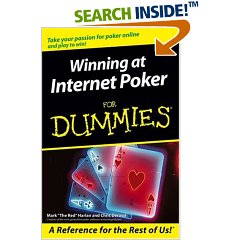 Author: Mark "The Red" Harlan, Chris Derossi
Publish Year: 2005
Edition: 1
Pages: 264
Price: $11.55
Sometimes when I read--and I use that word with some restrictive license--a "Dummies" or an "Idiot's" guide to a subject, I find myself thinking, "how aptly named!" This book is no exception. However--and really this is what is important--if you're new to online play, this is the book you want to peruse. It's very basic, almost painfully so in some respects, as all "Dummies" books are; but whether you are a neophyte poker player or an expert, this book will give you everything you need to know to begin playing online.
Notice I am not talking about reading the book from cover to cover. As the authors say in their introduction: "Read any chapter at any point. Feel free to skip around." They do a good job of giving the links and naming the sites--playing sites and sites associated with online poker. They explain how you can deposit money and they alert the reader to some of the dangers of online play. They even give advice on how to play. However, it doesn't take a genius to figure out that this might not be the best book to buy if you are interested in becoming a better player. What advice they do give is generally good although not of world class quality.
Here are a couple of examples that the causal player might want to skip:
[First, there's their analysis of a hold'em hand they observed being played at the $3 & $6 level (p. 138). I won't rehash the hand, but will observe that their conclusion that "Player 1 may have had A-K, or a large pocket pair, but dropped the hand when the other players clearly showed the board had paired" is faulty in several places. One, of course, is that the board had not paired. What they mean is that the bet, raise and re-raise action after the flop of 9s 10s Qd indicated that at least one of the players had a queen in hand and therefore had a pair. The fact that Player 1, with 17 bets in the pot, giving him 17 to 2 odds on his money by calling the raise and reraise, did NOT call strongly suggests that he did not have AK, since if he had he would have had two overcards and a draw to the nut straight, which has something like a 40% chance of improving on the river to a hand that could very well win the pot. It's hard to say what he had. It looks like he misplayed his hand. Furthermore, the authors don't give us the full story. At the showdown they reveal that the winner had AQ and won with just a pair of queens and the top kicker. They remark that the site folds the caller's cards because "the runner-up doesn't show." That's correct, but if you are in the hand and refer to the record of the hand that is sent to your computer on sites like PartyPoker, it will show all hands still in play at the showdown, and you could find out what the runner-up had.]
[Another example is on page 190 in the box discussing 2-2 vs. A-K. They say that it's a 50/50 proposition, but then contradict themselves by pointing out what most players know, namely that the deuces are a slight favorite head-up. Then they muddy these waters by saying, "The true odds vary from 50.3 percent versus 49.7 percent in favor of the pocket deuces to 53.2 percent versus 46.8 percent for the deuces, depending on the suits involved." Note that this is quote, unquote. It's a little unclear exactly what they are saying, but trust me the deuces are always the favorite. Their point (apparently) is that if the deuces are in the same suit as the aces, then, should four of either of those suits fall on the board, the deuces will always lose, thereby lessening their small advantage. However since one can never know until the hand is over just which suits the other player is holding, the proper way to figure the odds is to ignore the suits, since the distribution is not only unknown, but evens out over the long run. Furthermore, they are relying on the calculator at Card Player's Internet site, which is a Monte Carlo simulation, not an actual calculation of the odds. For most purposes, a simulation of a few thousand hands is sufficient. However, the real odds can only be figured out mathematically, which nobody these days, it appears, bothers to do. Well, I'm sure David Sklansky still figures his odds.]
These quibbles aside, Harlan and Derossi's book is well worth the investment, especially if you are a total newbie. They cover just about every aspect of the experience that a beginning online player would want to know about. Here's an example of their guidance under the subheading "Grappling with the Psychological Basics" on page 70: "From a psychological point of view, the biggest differences between online play and the brick-and-mortar world include the radical increase in the speed of play and a heavy (mental) disassociation from the money you put in play."
The plain fact of the matter is that when the dollars seem like virtual dollars (although they are not) there can be a tenancy to bluff too much, to play too loosely, and perhaps to play at a higher game than one can afford.
Another good (and very different) introductory book on cyberspace poker is John Vorhaus's Killer Poker Online, which I also recommend.
Incidentally, if you really are a beginner at poker, I recommend you buy a computer game and practice with that for a while, and then--as the authors recommend--play at the "play money" games that the online poker sites offer before you risk any real money.
| Related Content |
 1. Liar's Poker: Rising Through the Wreckage of Wall Street in the Book Review section.
|
|
2. The insider's guide to Turbo Texas hold-em in the Book Review section.
|
|
3. Hold 'em Poker for Winners: "Gamesman Hold-'Em" in the Book Review section.
|
| Comments |